
What Is LangChain? A Beginner’s Guide
If you've started learning AI development, you've probably heard of LangChain.
Some developers say it is essential. Others say you can build AI applications without it.
So what exactly is LangChain, why was it created, and when should you actually use it?
Let's start with the problem it was designed to solve.
The Problem: Building an AI Application
Imagine you're building an AI chatbot using a model such as GPT or Claude.
At first, it is simple:
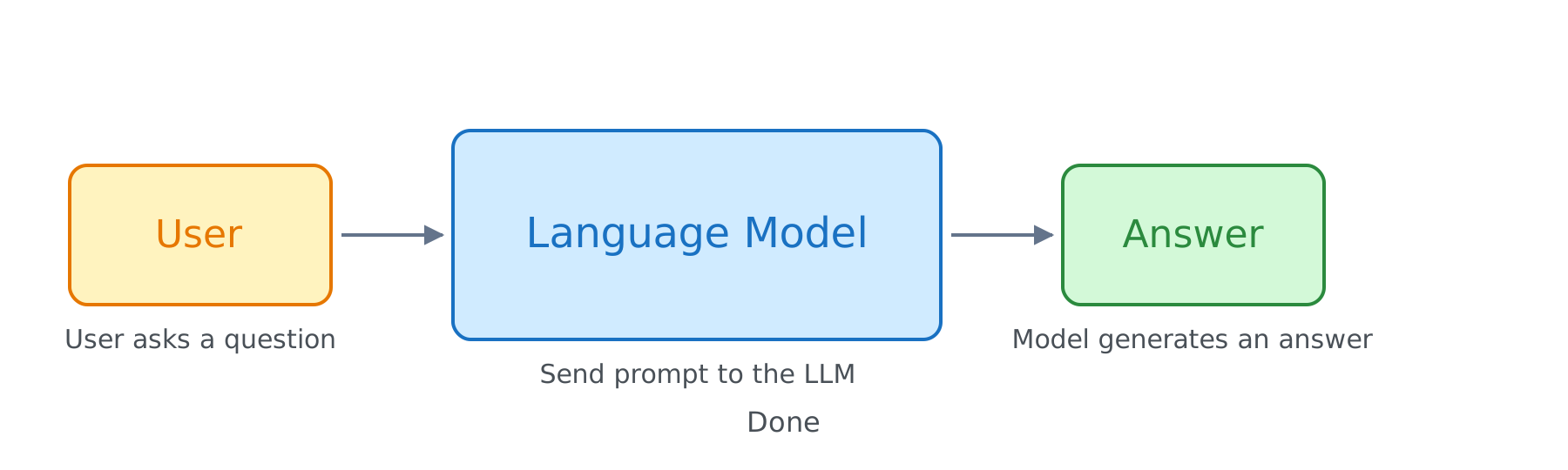
But real AI applications quickly become more complicated.
What if your chatbot needs to:
- answer questions from your company documents?
- search a database?
- remember previous conversations?
- call an external API?
- use different AI models for different tasks?
- use tools to complete actions?
Soon, your application contains a lot of custom code just to connect all these pieces together.
This is the problem LangChain was built to help solve.
LangChain is an open-source framework for building applications and agents powered by large language models. It provides reusable building blocks for connecting models, prompts, tools, data, and application logic rather than requiring you to build all of that infrastructure yourself.
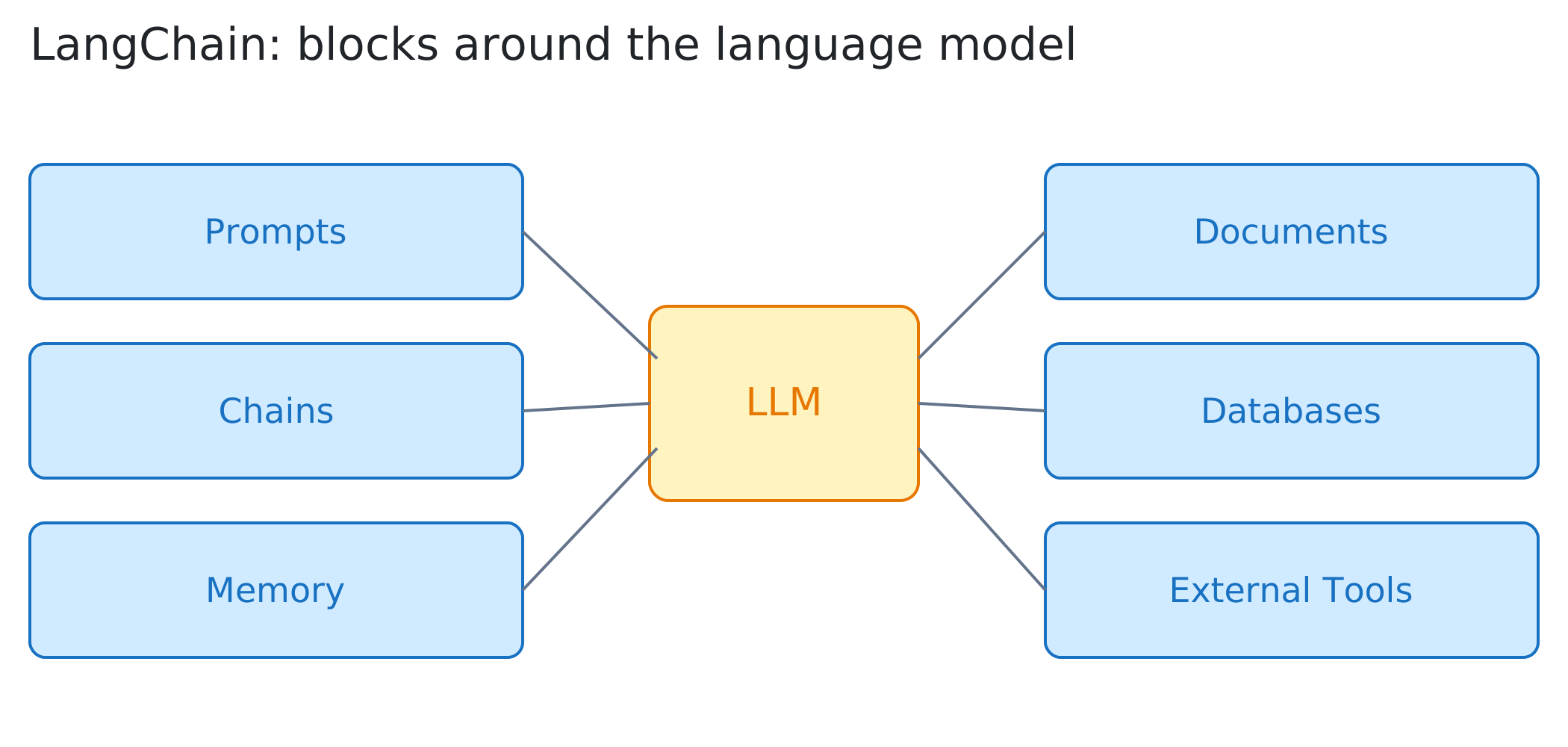
A simple way to think about LangChain is:
The language model is the brain. LangChain is the framework that helps connect the brain to everything else.
Let's look at some of its most important concepts.
1. Prompt Templates
Normally, you might write a prompt directly inside your code.
For example:
Give me the top programming languages to learn in 2026.
But in a real application, part of that prompt might need to change.
Instead, you could create something like:
Give me the top programming languages to learn in {year}.
Now {year} is a variable.
Your application can replace it with:
2026
2027
2028
...
This is the idea behind a prompt template: create a reusable prompt and insert dynamic values when the application runs.
Instead of manually rebuilding your prompt every time, you keep the structure and change only the information that needs to be different.
That makes prompts easier to reuse and maintain.
2. Chains
As the name suggests, a chain is a sequence of steps connected together.
Imagine a user asks your application a question.
The application might:
User Question
      ↓
Format Prompt
      ↓
Send to LLM
      ↓
Format Response
      ↓
Return Answer
Instead of treating each step as completely separate code, you can connect them into a workflow.
The useful idea here is modularity.
If you later want to replace the model, change the prompt, or add another processing step, you can change one part without rebuilding the entire application.
You will still hear the word chain used to describe this style of LLM workflow. In current LangChain, however, the framework is increasingly centered around composable model, tool, prompt, middleware, and agent building blocks; older chain classes such as LLMChain are now part of the legacy langchain-classic package.
The underlying idea remains simple:
Connect several AI-processing steps into one workflow.
3. Document Retrieval
Large language models do not automatically know what is inside your private company documents.
Imagine you ask:
"What is our company's refund policy?"
The answer might exist in a PDF or internal documentation, but the model does not automatically have access to it.
So the application needs to find the relevant information first.
A simple retrieval workflow looks like this:
User asks a question
        ↓
Search documents
        ↓
Find relevant information
        ↓
Send question + information to LLM
        ↓
Generate answer
This approach is commonly called Retrieval-Augmented Generation, or RAG.
LangChain provides components for building retrieval systems, including document loaders, text splitters, retrievers, and integrations with vector stores. Document loaders bring information from external sources into a standard format, while text splitters can divide large documents into smaller chunks that are easier to retrieve and fit into a model's context window.
This allows an AI application to answer questions using information from sources such as:
- PDFs
- company policies
- product documentation
- knowledge bases
- internal documents
So instead of relying only on what the model learned during training, you can provide it with the information it needs at the time of the question.
4. Memory
Now imagine this conversation:
You: What is Docker?
The AI gives you an explanation.
A few seconds later, you ask:
You: How is it different from Kubernetes?
What does "it" mean?
A human understands that you are still talking about Docker.
An AI application also needs access to the previous conversation to understand that context.
This is where memory comes in.
LangChain supports short-term memory that allows an agent to retain information from earlier interactions within the same conversation or thread.
Conceptually:
User: What is Docker?
        ↓
AI answers
        ↓
Conversation remembered
        ↓
User: How is it different from Kubernetes?
        ↓
AI understands "it" = Docker
Without the previous context, the second question is much harder to interpret correctly.
Memory helps make AI applications feel like ongoing conversations instead of a series of unrelated prompts.
5. Agents
The final major concept is agents.
A normal workflow often has steps that you define in advance.
For example:
Step 1 → Step 2 → Step 3
An agent is different because it can decide what to do next.
Imagine asking:
"Check today's weather and send me an email if it's going to rain."
The AI might need to:
Understand request
        ↓
Call Weather Tool
        ↓
Check Forecast
        ↓
Is rain expected?
     ↙       ↘
   Yes       No
    ↓         ↓
Send Email   Finish
You did not have to tell the agent:
First call the weather API, then inspect the result, then call the email service.
You gave it a goal.
The agent decides which tools it needs and can continue using tools until the task is complete. This model-and-tool loop is how LangChain currently describes its agent architecture.
That makes agents useful for applications where the exact sequence of actions is not always known ahead of time.
Should You Always Use LangChain?
No.
If your entire application does this:
Prompt → LLM → Answer
then using the OpenAI, Anthropic, or another model provider's SDK directly may be simpler.
You do not need a framework simply because you are using an LLM.
LangChain becomes more useful as you start needing things such as:
- reusable prompts
- document retrieval
- conversation memory
- multiple models
- tool calling
- agents
- more complex AI workflows
LangChain's current focus is to provide a relatively easy starting point for building LLM applications and agents while still allowing developers to customize the model, tools, prompts, middleware, and surrounding behavior.
Quick Recap
The main LangChain concepts are straightforward:
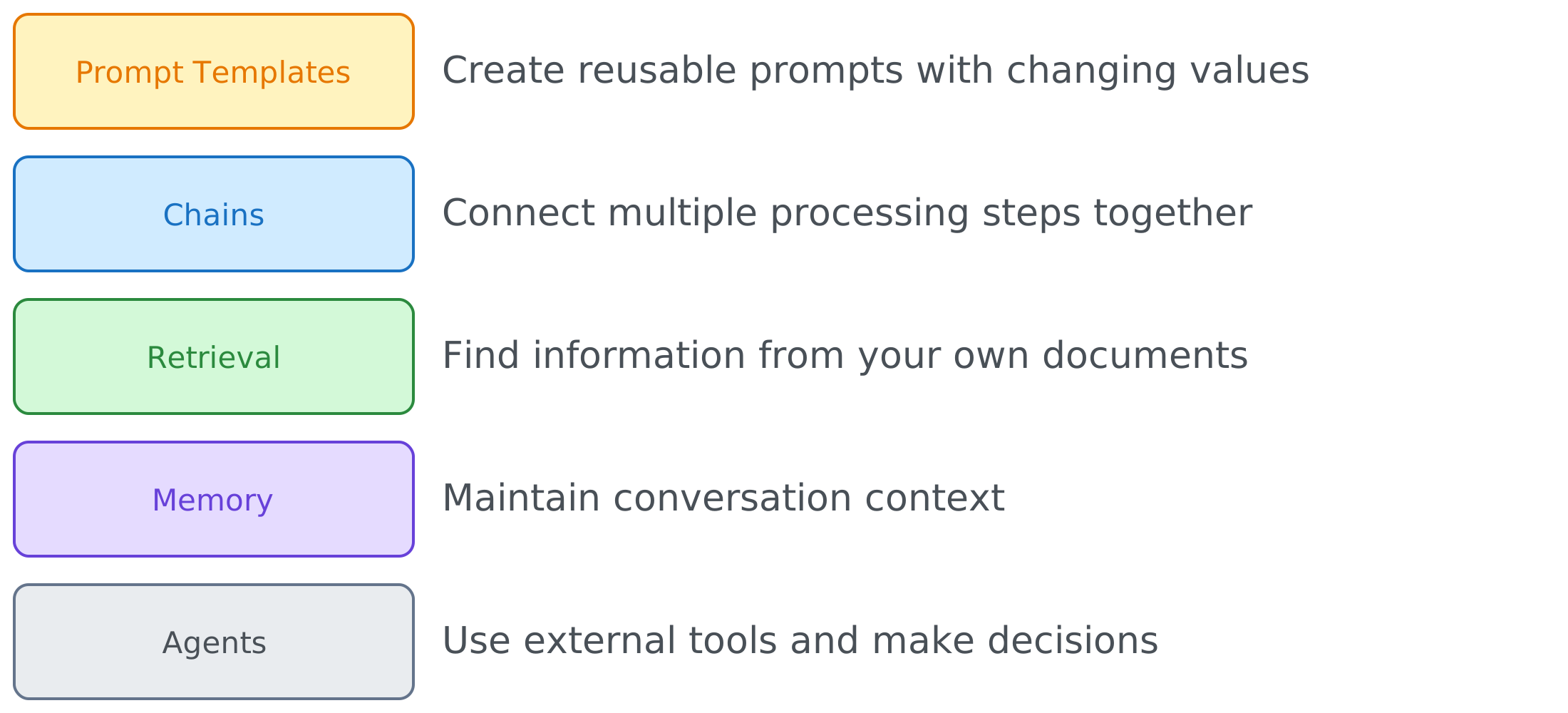
And underneath all of this, the language model is still the brain.
LangChain provides the framework around that model that helps connect it to prompts, information, tools, and application logic.
So, should you learn LangChain?
If you only want to send a prompt to an LLM and display the answer, probably not yet.
But if you want to build AI applications that work with documents, memory, tools, retrieval, or agents, understanding LangChain—and the concepts behind it—is well worth your time.